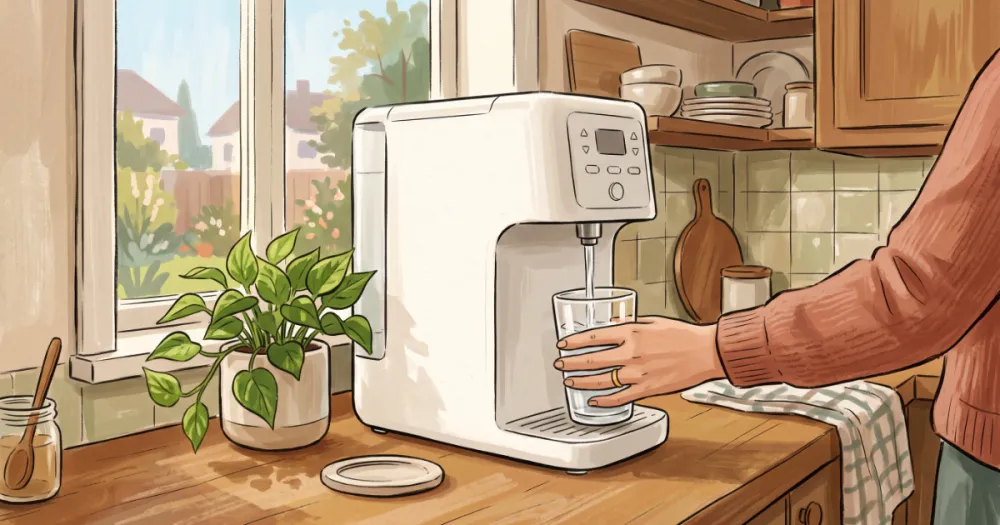
Is reverse osmosis water filtering worth it?
For contaminants a carbon filter can't touch — dissolved solids like fluoride, arsenic, nitrate, and PFAS — reverse osmosis is the most effective technology available at consumer scale, and one of the few the US EPA formally names as a "best available technology" for removing them — a designation the World Health Organization's own global guideline values for these contaminants back up well beyond the US. The tradeoff is real too: a standard system sends several gallons of water down the drain for every gallon it produces, and it strips out beneficial minerals right along with the contaminants. Whether that tradeoff is worth making depends entirely on what's in your water.
If you've read Is Your Tap Water Safe? or How to Choose a Water Filter That Works, you already know that "removes contaminants" is marketing filler until it's tied to a specific standard and a specific substance. Reverse osmosis is the one home filtration technology broad enough to earn a claim like that — but broad isn't the same as free, and it's worth understanding exactly what you're trading before you install one under your sink.
How Reverse Osmosis Works
Every other consumer water filter works by attracting or trapping contaminants as water flows past — activated carbon adsorbs chlorine and organic compounds onto its surface, for instance. Reverse osmosis works differently: it forces water through a semipermeable membrane with pores small enough, down to roughly 0.0001 micron, to physically block dissolved salts, metals, and minerals that flow straight through carbon media untouched.
That takes real pressure, because pushing water through a membrane that fine means working against the water's own natural osmotic pressure — the same force that normally pulls water toward the more concentrated solution, not away from it. A residential RO system reverses that flow, which is where the name comes from, and why the process needs a pump or household water pressure high enough to do the work.
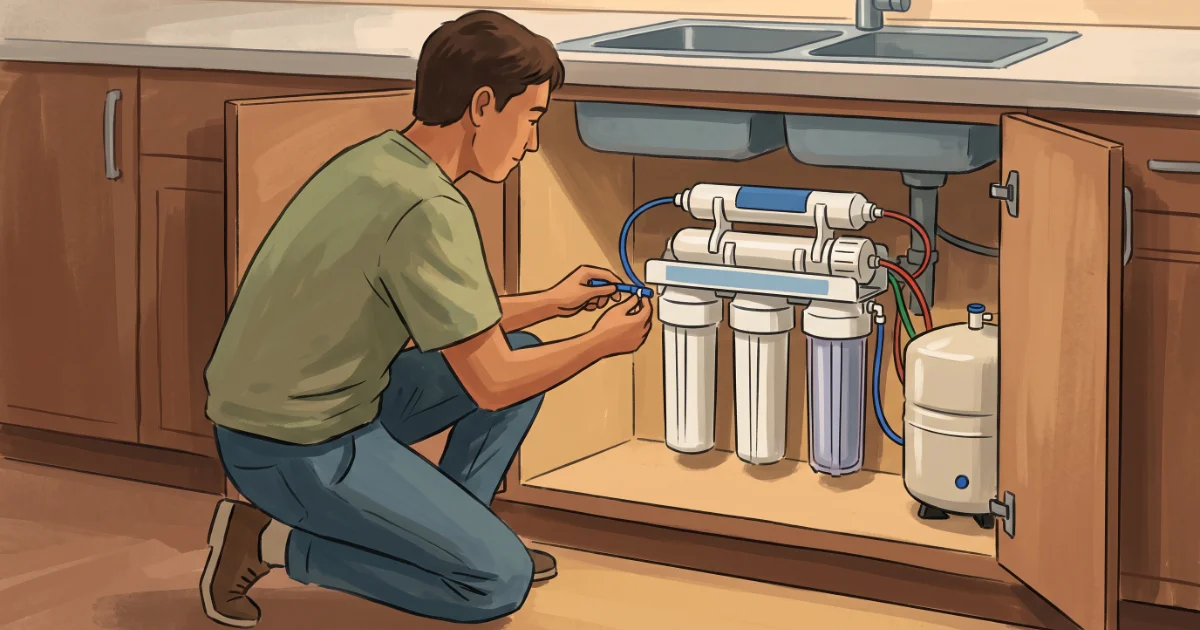
Most residential units aren't a single membrane — they're a short assembly line: a sediment pre-filter to catch grit before it can scratch the membrane, a carbon pre-filter to strip out chlorine (which degrades the membrane material over time), the RO membrane itself, and usually a carbon "polishing" filter afterward to clean up the taste of the water that made it through. This is the technology certified under NSF/ANSI 58 — a US-originated standard, but one so widely used internationally that it's worth checking for on any RO system regardless of where you're buying it — the same standard referenced in how to choose a water filter for exactly this reason. It's the certification that means something for dissolved-inorganic reduction.
What It Removes
The US Environmental Protection Agency (EPA) doesn't just recommend reverse osmosis as one option among many — it names RO directly as a "best available technology" under that country's Safe Drinking Water Act for three contaminants that pass straight through a standard carbon filter: arsenic, nitrate, and fluoride. These aren't a US-only concern: the World Health Organization sets its own global guideline values for the same three contaminants — arsenic at 10 µg/L, nitrate at 50 mg/L, and fluoride at 1.5 mg/L — so the underlying problem, and the case for RO as an effective response to it, holds well beyond the US. Carbon filtration works on organic compounds and chlorine byproducts; none of those three are organic, so a filter with no RO stage typically doesn't touch them at all, regardless of what the packaging implies.
Reverse osmosis carries that same designation for the newest generation of concern: under the US EPA's 2024 PFAS drinking water rule, RO, ion exchange, and nanofiltration are the three technologies named as best available for meeting the new PFAS limits. The EU has moved on the same concern from its own direction — the revised EU Drinking Water Directive introduced binding PFAS limits across all member states, with monitoring required from January 2026. In practice, a properly maintained RO system reduces total dissolved solids broadly — sodium, chloride, sulfate, most heavy metals, and most PFAS compounds along with the three named above — which is why it's the technology of choice when a water test comes back showing multiple dissolved contaminants rather than one specific one.
What It Doesn't Reliably Handle
Reverse osmosis is not a disinfection technology, and it isn't certified as one. Removing bacteria and viruses reliably is the job of a different standard entirely — NSF/ANSI 55 for UV treatment — and while an intact RO membrane does block most bacteria by sheer pore size, a system isn't designed, tested, or marketed around that job the way a UV unit is. If your water source is a well with a known bacterial risk, that's a separate problem RO alone doesn't solve.
It's also worth saying plainly: if chlorine taste and odor is your actual complaint, reverse osmosis is solving a problem you don't have. A basic NSF/ANSI 42 carbon filter handles that specific issue for a fraction of the cost, the waste, and the maintenance — matching the certification to the actual concern, as covered in the filter-buying guide, applies here too.
The Tradeoff Nobody Puts on the Box
Here's the part of the reverse osmosis conversation that rarely makes it into the marketing: producing one unit of clean water typically means sending several more down the drain. According to the US EPA's WaterSense program, a typical point-of-use RO system sends five gallons — about 19 liters — of water or more down the drain for every gallon (roughly 3.8 liters) of treated water it produces, and some inefficient units run as high as ten gallons wasted per gallon produced. WaterSense is a US certification program, but the membrane physics behind that ratio is identical everywhere, so it's a reasonable benchmark regardless of where you live.
That gap is exactly why WaterSense created a certification for RO systems in the first place. A WaterSense-labeled unit must independently verify at least 50% less water use than a typical system, capping reject water at 2.3 gallons (about 8.7 liters) per gallon of treated water — and the EPA estimates that switching from a typical unit to a WaterSense-labeled one saves the average household more than 3,100 gallons (about 11,700 liters) a year, or roughly 47,000 gallons (about 178,000 liters) over the system's lifetime. If you're in the US, that label is worth checking for the same reason an NSF certification number is — it's an independently verified figure, not a marketing claim. Outside the US, the label itself won't appear on most products, so ask for a manufacturer's stated pure-to-waste ratio backed by independent test data rather than trusting an unverified number on the box.
The other tradeoff is mineral content. Reverse osmosis doesn't distinguish between a contaminant and a beneficial mineral — calcium and magnesium get pulled out of the water right alongside arsenic and nitrate, producing water with very low total dissolved solids. The World Health Organization commissioned a dedicated review of exactly this question, published as a chapter in its 2005 report Nutrients in Drinking Water. The review's own conclusion is measured, not alarming: most people get the large majority of their calcium and magnesium from food, not water, so demineralized water isn't inherently dangerous in normal drinking amounts. The finding that draws more caution is regional — areas where the entire water supply is naturally very low in minerals show a correlation with higher cardiovascular mortality in population-level studies, a different situation from one household's RO unit used alongside an otherwise normal diet. It's part of why many modern residential systems now add a remineralization cartridge as a final stage, and worth considering if RO becomes your household's primary daily drinking water for years at a time.
Matching the Filter to the Problem, Not the Other Way Around
The three main home filtration categories solve genuinely different problems, and none of them substitutes for the others:
- Carbon filters (pitcher, faucet-mount, NSF/ANSI 42 or 53) — cheap, no wasted water, effective for chlorine taste and, if specifically certified for it, lead. Does nothing for fluoride, arsenic, nitrate, or high TDS.
- Whole-house carbon systems — treat every tap in the house, which matters for VOC exposure through steam while showering, not just drinking water. Same blind spot as a pitcher filter on dissolved inorganics unless an RO stage is added.
- Reverse osmosis (NSF/ANSI 58) — the broadest reduction of dissolved contaminants available at consumer scale, but slow flow rates and wastewater mean it's almost always installed as a single point-of-use tap with a small storage tank, not a whole-house solution.
The order of operations that works, same as with any filter purchase: get your actual water data first — your utility's water quality report (a Consumer Confidence Report in the US, an equivalent published elsewhere) if you're on municipal supply, a lab test if you're on a well — and let what's in your water determine the technology, instead of picking a technology and hoping it covers whatever's there.
Choosing the Right Amount of Intervention
It's tempting to treat "removes the most" as the same thing as "best," and reverse osmosis is genuinely the most aggressive consumer filtration technology available. But the most aggressive tool isn't automatically the sovereign choice — the informed one is. A household on municipal water with a clean water quality report and no lead service line may need nothing more than a basic carbon filter for taste. A household with a well test showing arsenic or nitrate has a specific, solvable problem that genuinely calls for RO. Knowing the difference, instead of defaulting to whichever system is marketed hardest, is what understanding your own water looks like in practice.
This Week
Pull your water utility's most recent water quality report — in the US that's your Consumer Confidence Report; elsewhere, check your water provider's site or your national drinking-water regulator — or order a well-water test if you're not on municipal supply, and check specifically for arsenic, nitrate, fluoride, and PFAS: the contaminants that justify reverse osmosis. If you already have an RO system or you're buying one, look for the NSF/ANSI 58 certification (searchable at info.nsf.org, which covers products sold in many countries). If you're in the US, also check for the WaterSense label, the only independently verified answer to how much water a system is wasting; elsewhere, ask the manufacturer for independent test data on the pure-to-waste ratio instead.
If this was useful, share it with someone who's been running an RO system for years without knowing what it's filtering out — or how much water it's sending down the drain to do it.
Free Guide: A Practical Guide to Home Water Filtering
Most people buy a water filter based on the product label and not based on their own water. This practical free guide shows you how to check the quality of your water and then understand how to choose the type of filter solution needed. 34 pages covering every major contaminant, all seven filter technologies, and how to verify any certification claim yourself.
Get It FreeA note about this blog post:
This post was researched and drafted with AI assistance, directed, reviewed, and edited by Cato B. Hagen. All claims are checked against real sources before publishing.