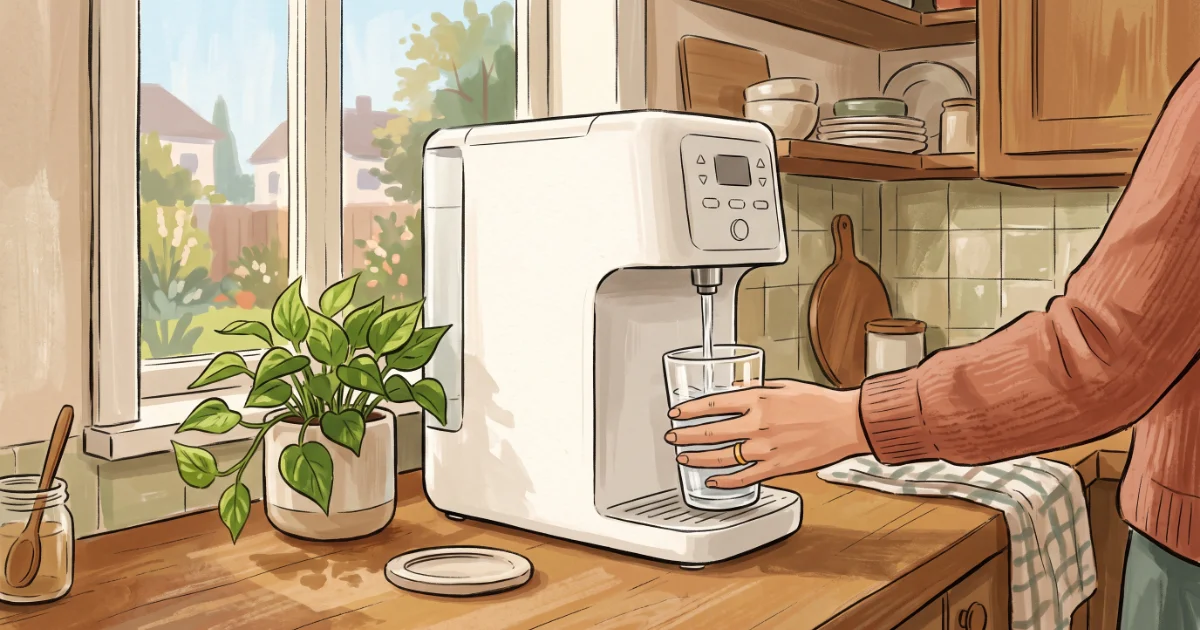
Are countertop reverse osmosis machines worth it?
A countertop reverse osmosis machine uses the same membrane technology as an under-sink system, so it removes the same category of dissolved contaminants — fluoride, arsenic, nitrate, PFAS — without drilling into a cabinet, adding a dedicated faucet, or touching your plumbing at all. That makes it one of the only genuinely effective options for renters. The tradeoffs are real too: smaller daily output, manual refilling, and usually a higher price per gallon than a fixed system that runs continuously off your water line.
Whether that trade is worth it comes down to one question: do you own your plumbing, or are you working around someone else's?
How These Are Different From an Under-Sink System
An under-sink reverse osmosis system taps directly into your cold water line and typically uses your home's own water pressure — or a small booster pump — to force water through the membrane continuously, sending the filtered stream to a dedicated faucet and the reject water down the drain. A countertop unit is built to skip all of that.
Most countertop RO machines fall into one of two designs. A freestanding, fill-and-pour unit has no plumbing connection at all — you pour water into a top reservoir, an internal electric pump forces it through the membrane stack, purified water collects in a lower tank you dispense from, and the reject water collects separately in its own internal container that you empty periodically. A faucet-diverter unit connects with a hose to your existing kitchen faucet, filters on demand, and routes reject water back into the sink through a second hose rather than storing it. Both skip the cabinet drilling and dedicated faucet that an under-sink install requires — which is the entire point for a renter.
What It Removes (Same Membrane, Same Result)
The contaminant-removal profile isn't a function of where the machine sits — it's a function of the membrane and whether it's certified. The US EPA's designation of reverse osmosis as a best available technology for arsenic, nitrate, and fluoride, and as one of the named technologies for meeting the 2024 PFAS drinking water limits, describes the underlying RO process itself, not a specific product format — the same holds under the World Health Organization's global guideline values for those contaminants, and under the EU's own PFAS limits for drinking water taking effect in 2026. A genuinely NSF/ANSI 58-certified countertop membrane removes the same category of dissolved contaminants as a certified under-sink one, regardless of which country it's sold in.
The caveat is that "genuinely certified" is doing real work in that sentence. Countertop RO is a newer, fast-growing, largely direct-to-consumer product category, which means more brands making broad removal claims without an actual NSF listing behind them. The same ninety-second check that applies to any water filter applies here, maybe more so: search the exact model at info.nsf.org before buying, and don't take a percentage claim on a product page as equivalent to an independent certification.
The Real Tradeoffs of Going Countertop
- Lower daily output. A countertop unit produces water in batches into a limited reservoir, not continuously off the line. That's plenty for drinking and cooking for most households, but it isn't sized to be your whole kitchen's water supply the way a plumbed system can be.
- Wastewater is visible instead of hidden. A freestanding unit's reject water collects in a container you physically empty — you see exactly how much is being wasted, which a drain-connected system never shows you. Manufacturers commonly advertise pure-to-waste ratios somewhere in the range of roughly 1:1 to 4:1, but unlike the US EPA's WaterSense figures that apply to plumbed-in point-of-use systems, these are manufacturer-reported numbers for a category WaterSense's own specification doesn't clearly address for non-drain-connected units — and WaterSense itself is a US-only program with no direct equivalent most other countries currently publish. Treat a specific ratio claim on a product page the same way you'd treat any uncertified performance number — worth checking for independent testing before trusting it as precise.
- Remineralization is often standard, not an add-on. Many countertop systems build a remineralization stage into the base design by default, which addresses the mineral-stripping tradeoff of reverse osmosis more directly out of the box than most under-sink units, which usually treat it as an optional extra cartridge.
- Cost per gallon tends to run higher. You're paying for the convenience of no installation and portability, and that shows up in both the upfront price and cartridge replacement costs relative to a comparable fixed system.
Who This Makes Sense For
A countertop machine is the right tool when the constraint isn't the water — it's the lease. Renters, apartment dwellers, and anyone who moves every year or two get the same filtration technology as a permanent installation without asking a landlord's permission or losing the investment when they leave. It's also a reasonable way to find out whether reverse osmosis is worth committing to at all before drilling a hole in a cabinet you might regret.
An under-sink system still makes more sense once you're not working around someone else's plumbing: higher daily volume, a dedicated faucet that behaves like a normal tap, and no reservoir to remember to refill. Same technology, same certification to check for — the choice is really about how long you expect to be standing in that kitchen.
One More Way to Start Without Waiting for the Right House
Most water-filtration advice quietly assumes you own the pipes. A countertop unit is a genuine example of engineering a real improvement to your water from wherever you are right now, rented apartment included, instead of treating good filtration as something you get to once you own a house. Sovereignty over your water doesn't require owning the plumbing it runs through.
This Week
Pull your water utility's most recent water quality report — in the US that's your Consumer Confidence Report; elsewhere, check your water provider or national drinking-water regulator — or a well test if you're not on municipal supply, and check for the same contaminants that justify any reverse osmosis purchase: arsenic, nitrate, fluoride, PFAS. If a countertop unit is on your list, search its exact model at info.nsf.org (covering products sold in many countries) for an NSF/ANSI 58 listing before you buy, and don't treat an advertised waste ratio as verified unless you can find independent testing behind it.
If this was useful, share it with someone who assumed reverse osmosis meant calling a plumber first.

Free Guide: A Practical Guide to Home Water Filtering
Most people buy a water filter based on the product label and not based on their own water. This practical free guide shows you how to check the quality of your water and then understand how to choose the type of filter solution needed. 34 pages covering every major contaminant, all seven filter technologies, and how to verify any certification claim yourself.
Get It FreeA note about this blog post:
This post was researched and drafted with AI assistance, directed, reviewed, and edited by Cato B. Hagen. All claims are checked against real sources before publishing.