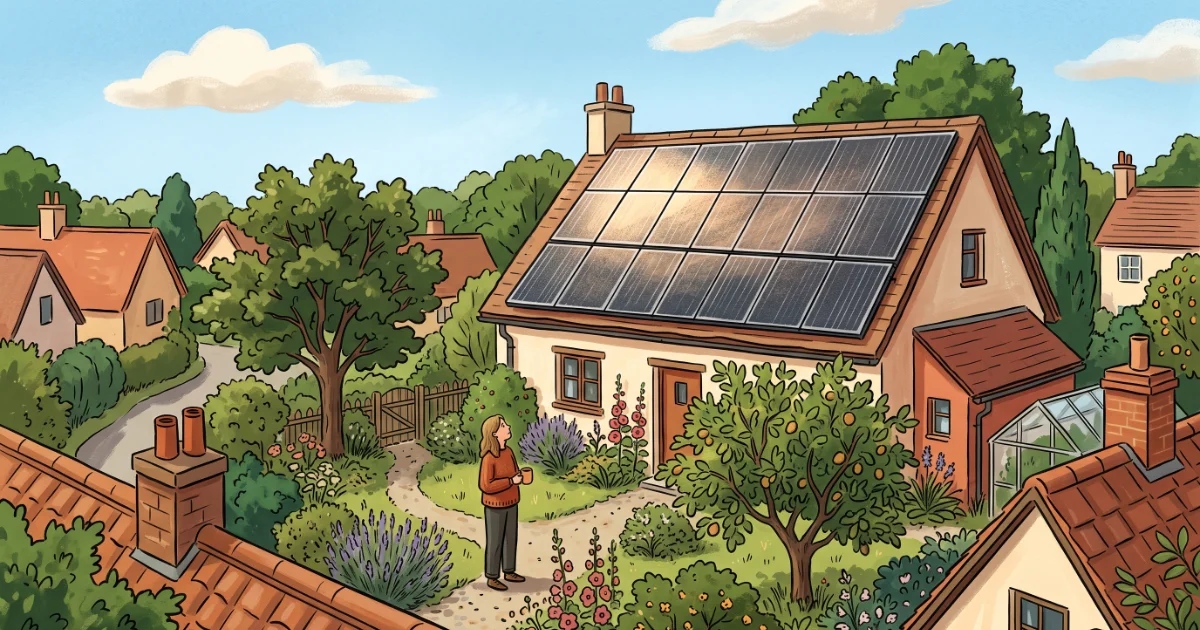
Does solar actually pay for itself, and what happens to your output on the days the sun doesn't cooperate?
Yes, in most cases — typical payback periods run six to twelve years depending on your local electricity price and sun hours, and panels still produce meaningfully on cloudy days, usually 10 to 25 percent of clear-sky output rather than nothing.
That's the real question worth answering honestly before you commit — not the marketing promise of a bill that disappears overnight, but a genuine, gradual shift in how much of your own energy you actually produce. The realistic version looks like this: a sunny afternoon, an app on your phone showing your panels covering most of the house's current draw — the washing machine running, the kettle just switched off, the meter barely moving.
How Solar Actually Works, Briefly
Photovoltaic cells convert sunlight into direct current electricity, which an inverter then converts into the alternating current your home actually uses. The important detail most people miss: panels respond to daylight, not just direct sunlight. On an overcast day, output typically drops to somewhere between 10 and 25 percent of a clear-sky day, depending on cloud density — reduced, but very much not zero. A well-sized system accounts for your region's real weather patterns over a full year, not just its sunniest days.
Does the Math Actually Work?
Solar has gone from a niche, expensive technology to a mainstream one remarkably fast. The International Energy Agency has tracked module costs falling roughly 80 percent or more since 2010, which is the single biggest reason payback periods have shortened so much over the past decade.
Typical payback periods — the time for saved electricity costs to cover the installation cost — commonly fall somewhere between six and twelve years, depending heavily on your local electricity price, how much sun your specific location gets, and whether any government incentives or rebates apply. Panels are generally warrantied for 25 years and often keep producing meaningfully beyond that, which means a system with an eight-year payback could still be generating close to free electricity for well over a decade afterward.
That range is wide on purpose — the honest answer is that solar economics are genuinely local. A household in a sun-rich region with high electricity prices and a solid rebate program has a very different payback timeline than one in a cloudy region with cheap grid electricity and no incentives. Run your own numbers before trusting anyone's global average, including this one.
What It Actually Takes to Get This Right
1. Check Your Roof First
Orientation, tilt, shading from trees or nearby buildings, and the roof's remaining lifespan all matter more than panel brand. A technically excellent system on a badly shaded or aging roof underperforms a modest system installed well. If your roof needs replacing within the next five years, that's a conversation to have before installing anything on top of it.
2. Get Your Real Usage Data First
Pull twelve months of actual electricity bills before anyone sizes a system for you. Usage varies by season, and a system sized only to your summer bill will underperform in winter. Right-sizing to your actual annual pattern matters more than maximizing the number of panels you can fit on the roof.
3. Understand Grid-Tied vs. Off-Grid Before You Decide
Most solar installations are grid-tied — no battery, using the grid itself as backup and, where net metering exists, selling surplus back to it. This is the cheapest option and the fastest payback, but it still leaves you dependent on the grid during outages. Adding battery storage enables real backup power and, at larger scale, genuine independence from the grid entirely — but batteries are typically the single most expensive part of the system, and they meaningfully extend the payback period. Decide which problem you're actually solving — lower bills, or real independence — because the right system size and cost differs significantly between the two.
4. Get Multiple Quotes, and Compare on Cost per Watt
Installer quality varies enormously, and so does pricing for what's nominally the same system. Get at least three quotes, compare cost per watt rather than total price alone, and check installer certification and independent reviews — not just the ones the company shows you.
5. No Roof of Your Own? You're Not Excluded
Renters and apartment dwellers aren't locked out of this energy solution. Community solar programs — where you buy or subscribe to a share of a larger, off-site solar installation — and green energy tariffs from your utility provider are both real ways to move toward energy sovereignty without owning a roof.
Where Solar Fits in the Bigger Picture
Solar is the practical, well-established starting point for Energy Freedom — the step with the clearest math and the least uncertainty. It's worth saying honestly that the fuller vision in The Sovereign Life goes further than solar alone, into more speculative territory around alternative generation methods and the history of energy research that's been actively suppressed. That's genuinely interesting ground, but it's a different kind of claim than "solar panels have a six-to-twelve-year payback" — one covered in more depth, with the hedging it deserves, elsewhere on this site.
Start with what's provable. Solar is where energy sovereignty stops being a vision and starts being a spreadsheet you can actually run.
Your Next Step
Pull your last twelve months of electricity bills this week. That single piece of data is what every legitimate solar quote should be built from — and it's the fastest way to find out whether the math actually works for your specific home.
This is one piece of the Energy Freedom picture. The Sovereign Life walks through the fuller picture of what energy sovereignty looks like, alongside the other six dimensions of a genuinely sovereign life.
If this was useful, share it with someone who keeps meaning to look into solar but hasn't run the actual numbers yet.