Does standing barefoot on grass for ten minutes actually do anything to your body, or is grounding just a pleasant walk with a wellness story attached to it?
There's real peer-reviewed research showing grounding reduces inflammation, improves sleep, and lowers stress — but the field is still small, and not every study has been independently replicated. The honest answer: probably yes, to a modest degree, and it costs nothing to test on yourself.
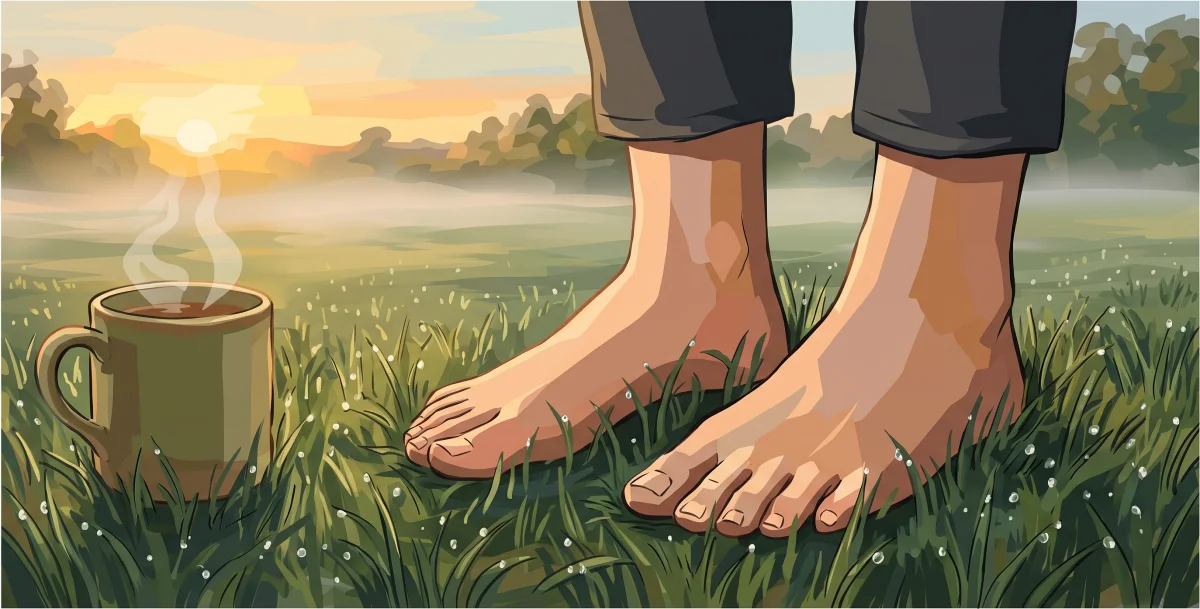
It's become popular enough — and expensive enough, once you factor in grounding mats and sheets — that the question is worth asking directly rather than assuming either answer. An ordinary version of the practice looks like this: coffee in hand, stepping outside, standing barefoot on the grass for a few minutes before the day starts properly. No app, no subscription, no equipment. Just skin against soil, the way every human being lived for the vast majority of history — before rubber soles and insulated floors put a permanent barrier between the body and the ground it evolved on.
What Grounding Actually Is
The mechanism is straightforward physics, not mysticism. The Earth's surface carries a continuous, mild negative electrical charge, replenished constantly by the global atmospheric electrical circuit — the ongoing background hum of lightning activity happening somewhere on the planet at all times. Free electrons sit at that surface, available to anything in direct contact with it.
The human body, by contrast, tends to carry a positive charge in modern life — largely from chronic exposure to electrical infrastructure and synthetic materials, combined with the fact that rubber-soled shoes and elevated, insulated buildings keep almost everyone permanently disconnected from the ground itself. When bare skin makes direct contact with a conductive natural surface — grass, soil, sand, or stone — electrons flow from the Earth into the body, and the electrical potential between the two equalizes.
That's the whole mechanism. What's actually in question is whether that equalization does anything measurable to human physiology.
What the Research Shows
Here the picture is genuinely better than "wellness trend" implies, though not as settled as some grounding-product marketing suggests. There is a real body of peer-reviewed clinical research on this — not just testimonials. Published studies have measured reductions in inflammatory markers, normalized cortisol rhythms, improvements in blood viscosity and red blood cell zeta potential (a measure of how freely blood cells flow rather than clump), better sleep quality, reduced chronic pain, and faster wound healing in grounded versus ungrounded subjects. A 2012 review in the Journal of Environmental and Public Health concluded that grounding appears to be one of the most effective, low-cost environmental interventions available against chronic inflammation, stress, and sleep disruption.
That's the honest positive case. The honest caveat: this remains a relatively small research field. Study sizes are often modest, some of the funding behind grounding research has come from companies that also sell grounding products — a real conflict of interest worth knowing about — and independent replication at larger scale is still limited. That doesn't make the findings worthless. It means "promising and mechanistically plausible" is the accurate description, not "definitively proven."
How to Actually Do It
The good news is that testing this for yourself costs nothing and requires no equipment.
Get Your Feet on Real Ground
Grass, soil, sand, and natural stone are all conductive. Concrete is mildly conductive too, which matters if you live somewhere without a garden — a bare concrete patio or a park path still works. Asphalt, wood decking, and any synthetic surface are not conductive and won't produce the effect.
Twenty minutes of direct barefoot contact per day is the amount most commonly used in the published research, though shorter sessions still register measurable effects. A few practical ways to fit it in:
- Take your coffee or tea outside and stand or sit on grass instead of a chair, for the first ten minutes of the morning
- Walk barefoot on a beach or a lawn whenever you're near one — this is the single easiest, zero-effort version
- If you have any patch of soil, sand, or grass at all — a courtyard, a park nearby, a balcony with a planter big enough to stand a foot in — use it, even briefly
What to Do Without Access to Ground (City Flats, Winter, Rain)
Not everyone has a garden, and not every climate makes barefoot mornings realistic year-round. Conductive grounding mats and sheets — connected to a building's electrical grounding point rather than the earth directly — let you access some of the same effect indoors, typically used under a desk or on a bed. They're a genuine second-best option, not a gimmick, though direct contact with natural ground remains the more studied and more effective version.
Why This Belongs in a Sovereign Life
You don't need a study to justify twenty minutes barefoot on grass — it costs nothing and the downside is essentially zero. But it's a useful example of what a sovereign approach to health actually looks like: not blind faith in a practice because it feels ancient and natural, and not dismissal of it because it isn't yet backed by a hundred large randomized trials. Just an honest look at what's known, what's still open, and a decision to test it on yourself rather than take either side's word for it.
That's a smaller version of the same shift that runs through every dimension of a sovereign life: understanding what your body actually needs, rather than assuming the modern default — shoes, floors, walls — was ever designed with that need in mind.
Try It This Week
Ten minutes, bare feet, real ground, once a day, for a week. Notice what changes about your sleep or your general sense of ease — then decide for yourself whether the research matches your own experience.
This is one piece of the Health Freedom picture. The Sovereign Life walks through the fuller picture of what a sovereign approach to health looks like, alongside the other six dimensions of a genuinely sovereign life.
If this was useful, share it with someone who spends their whole life on concrete, carpet, and rubber soles without ever noticing it.