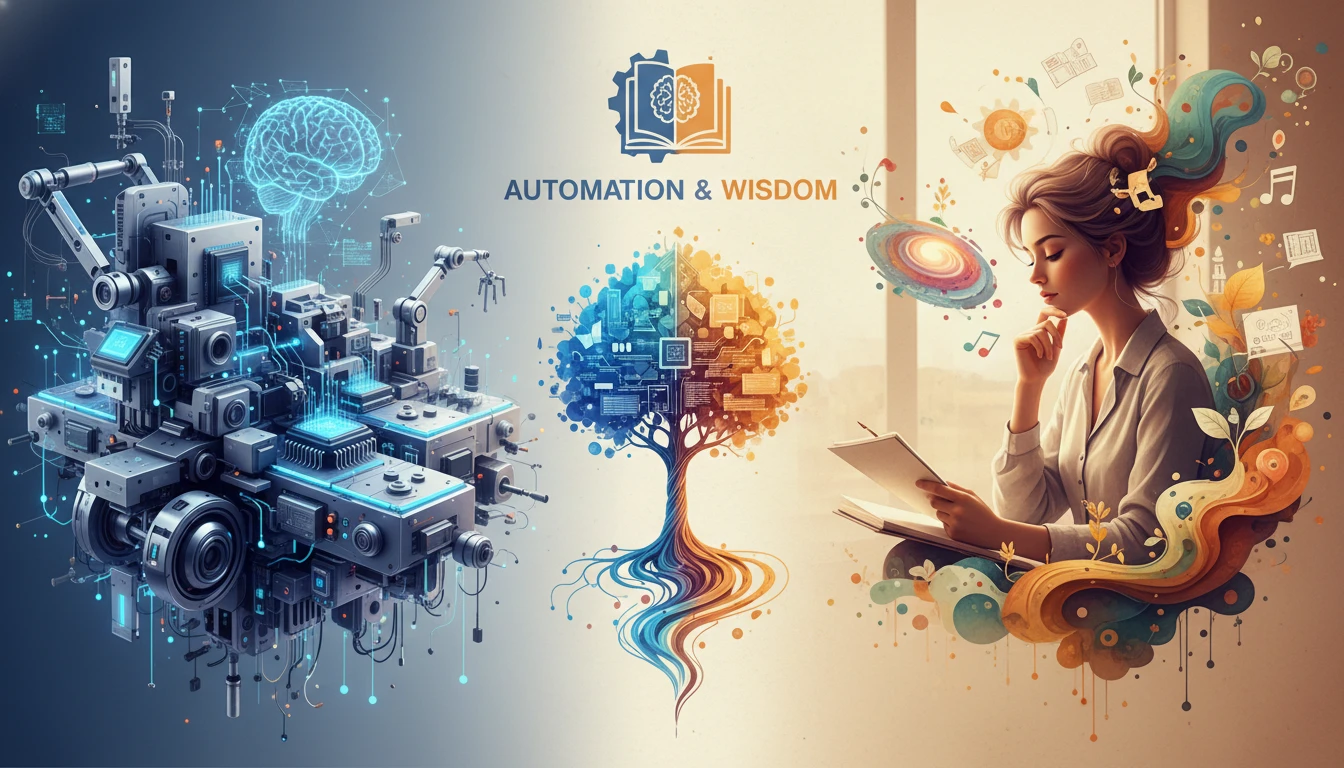
The Wisdom to Know the Difference: When to Automate and When to Think
The Prayer for Modern Work
Grant me the wisdom to automate what should be automated, the judgment to preserve what requires human insight, and the discernment to know the difference.
We're in the middle of an automation revolution. AI can draft emails, analyze data, generate reports, schedule meetings, and handle countless tasks that used to require human time.
The question everyone's asking: "What should I automate?"
But that's the wrong question.
The right question is: "What should I never automate?"
Because the answer to that question reveals what makes your work meaningful, what develops your skills, and what creates genuine value.
Everything else? Let the machines handle it.
The Mistake Everyone Makes
When people first encounter powerful automation tools, they make one of two errors:
Error 1: Automate Nothing
"I need to stay involved in everything. What if something goes wrong? What if I miss something important?"
Result: Drowning in routine work. No time for what matters. Stressed and overwhelmed.
Error 2: Automate Everything
"Let AI handle it all! I'll just review the output and make occasional adjustments."
Result: Atrophied judgment. Loss of expertise. Diminished ability to recognize quality. Eventually, inability to add meaningful value.
The wisdom is in the middle.
Automate ruthlessly. But preserve jealously what makes you valuable.
What You Should Always Automate
Some work is necessary but doesn't require human judgment. It's repetitive, rules-based, and predictable.
This work should be automated immediately:
1. Sorting and Filtering
- Email triage and categorization
- Data organization
- File management
- Spam and priority detection
Why: These follow clear rules. No judgment required. Perfect for automation.
2. Routine Responses
- Acknowledging receipt of messages
- Answering common questions with standard answers
- Scheduling meeting follow-ups
- Status update requests
Why: If you're saying the same thing repeatedly, you shouldn't be saying it. Automate it.
3. Data Processing
- Report generation
- Metric tracking
- Formatting and standardization
- Routine calculations
Why: Computers are better at this than humans. More accurate, faster, and they don't get tired.
4. Scheduling and Coordination
- Meeting scheduling
- Calendar management
- Reminder sending
- Routine follow-ups
Why: This is coordination, not thinking. Automation excels here.
The Freedom Rule
If automating a task would free more than 30 minutes per week with minimal risk, automate it immediately. That's 26 hours per year returned to meaningful work.
What You Should Never Automate
Other work requires uniquely human capabilities: judgment, creativity, empathy, strategic thinking, ethical reasoning.
This work should never be fully automated:
1. Strategic Decisions
- Setting direction and priorities
- Evaluating tradeoffs between competing goals
- Deciding what to build or pursue
- Determining values and principles
Why: These shape everything that follows. They require wisdom, not just analysis.
Example: AI can analyze market data. But deciding which market to enter—balancing risk, values, capabilities, and vision—requires human judgment.
2. Creative Problem-Solving
- Designing novel solutions
- Connecting seemingly unrelated ideas
- Imagining possibilities that don't yet exist
- Innovating beyond current approaches
Why: Machines optimize within known patterns. Humans create new patterns.
Example: AI can suggest variations on existing solutions. But breakthrough innovations come from human insight and creativity.
3. Relationship Building
- Understanding unspoken concerns
- Building trust over time
- Reading emotional context
- Navigating complex interpersonal dynamics
Why: Genuine relationships require presence, empathy, and authenticity—distinctly human qualities.
Example: AI can draft a message. But knowing when to send a message versus making a phone call versus visiting in person? That's human judgment.
4. Ethical and Value Judgments
- Determining right from wrong in ambiguous situations
- Balancing competing values
- Considering long-term societal impact
- Making decisions that affect people's lives
Why: Ethics require wisdom, empathy, and the ability to grapple with complexity. These can't be reduced to rules.
Example: AI can analyze the financial impact of a decision. But deciding whether that decision is ethical given its effect on employees, customers, and community? Human responsibility.
5. Learning and Skill Development
- Struggling with challenging problems
- Developing expertise through practice
- Building intuition through experience
- Understanding why something works
Why: Automation can handle tasks. But if you automate away all challenge, you stop developing.
Example: A calculator can do math. But if you never do math yourself, you lose mathematical reasoning. The same applies to any skill.
The Atrophy Trap
If you automate tasks that develop your expertise, you'll gradually lose the ability to recognize quality, spot problems, and make informed decisions. Automate the routine, not the developmental.
The Gray Area: When It's Complicated
Most tasks aren't purely automatable or purely human. They exist in the middle.
Here's how to navigate the gray area:
The Hybrid Approach
Let automation handle components while you provide judgment.
Example: Email Responses
Automate: Drafting initial response based on message content
Human: Reviewing tone, adding personal touches, adjusting for relationship context, deciding whether response is even appropriate
Example: Data Analysis
Automate: Gathering data, running calculations, generating visualizations
Human: Interpreting significance, questioning assumptions, deciding what to do with insights
Example: Content Creation
Automate: Researching background information, drafting initial structure, checking grammar
Human: Determining message, shaping narrative, ensuring accuracy, adding unique perspective
The Decision Framework
For any task, ask:
1. Does this require judgment that only I can provide?
- Yes → Keep it
- No → Consider automating
2. Does doing this task develop skills I need?
- Yes → Keep it (at least sometimes)
- No → Consider automating
3. Does this task create genuine value or just activity?
- Genuine value → Examine carefully before automating
- Just activity → Automate immediately
4. Would automating this put me out of touch with important realities?
- Yes → Keep involvement (maybe in sampled form)
- No → Automate safely
Real-World Examples
Case Study 1: The Marketing Director
Before: Spent 10 hours weekly on:
- Email management (3 hours)
- Report generation (2 hours)
- Meeting scheduling (1 hour)
- Routine status updates (2 hours)
- Strategic planning (2 hours)
After Wise Automation:
Automated:
- Email sorting and routine responses (saved 2 hours)
- Automatic report generation (saved 1.5 hours)
- Calendar scheduling AI (saved 45 minutes)
- Templated status updates (saved 1.5 hours)
Kept Human:
- Strategic planning (expanded to 5 hours)
- Creative campaign development (added 3 hours)
- Team mentoring (added 2 hours)
Result: Same 10 hours. But now spent on work that requires her unique judgment and creates real value. Stress down. Impact up.
Case Study 2: The Product Manager
The Temptation: Automate all customer feedback analysis using AI sentiment analysis.
The Wisdom: Use AI to categorize and surface patterns. But read actual customer messages regularly.
Why: Reading real customer words—their frustrations, hopes, and language—develops intuition that no summary can provide. It keeps him connected to user reality.
The Approach:
- AI analyzes all feedback (100%)
- AI surfaces top issues and patterns
- He reads representative samples (10%)
- He makes product decisions (100% human)
Result: Efficiency without disconnection. Data-informed decisions without losing touch with human reality.
The Long-Term Perspective
This isn't just about this week's workload. It's about who you're becoming.
Every task you do repeatedly shapes your capabilities.
Automate routine tasks, and you free time for complex challenges. Face complex challenges regularly, and you develop advanced skills. Develop advanced skills, and you create increasing value.
Or...
Automate everything including the challenging parts. Face only simple decisions. Never develop deeper expertise. Gradually become replaceable yourself.
The pattern compounds over years.
Ten years from now, do you want to be:
- Someone whose judgment is sought because of deep expertise built through years of grappling with hard problems?
- Someone whose role could be automated because you automated away all the work that developed your judgment?
The North Star Question
"Is this automation freeing me to do more valuable work, or is it preventing me from developing valuable capabilities?"
If it's the former, automate eagerly. If it's the latter, pause and reconsider.
The Societal Dimension
Your automation choices don't just affect you. They affect everyone.
When we automate wisely:
- Humans focus on work that develops capabilities
- Machines handle repetitive tasks
- Overall productivity increases
- Work becomes more meaningful
- Society advances
When we automate carelessly:
- Humans lose skills and judgment
- We become dependent on systems we don't understand
- Errors compound because no one can spot them
- Work becomes less meaningful
- Society becomes more fragile
You're not just making personal productivity choices. You're participating in shaping the future of work.
Make choices that preserve and develop human capability. Use automation to enable human flourishing, not replace human judgment.
Practical Guidelines for Daily Decisions
Morning Review: What to Automate This Week
Look at your task list and ask:
For each task:
- Does this require my unique judgment? (No → automate)
- Could someone else do this following a clear process? (Yes → automate)
- Am I doing this repeatedly? (Yes → automate)
- Does this task drain energy better used elsewhere? (Yes → automate)
Monthly Audit: Am I Automating Wisely?
Check for warning signs:
- ❌ Am I less capable of solving hard problems than I was six months ago?
- ❌ Have I lost touch with details that matter?
- ❌ Do I struggle to evaluate quality because I rarely do the work myself anymore?
- ❌ Am I just managing automation rather than creating value?
Check for healthy signs:
- ✅ Am I facing more challenging and interesting problems?
- ✅ Am I developing skills that increase my value?
- ✅ Do I have time for strategic thinking?
- ✅ Am I more effective at the work that matters most?
The One-Hour Test
For any automation you're considering:
Spend one hour per month doing the task manually.
If it's email sorting, manually sort email for an hour. If it's data analysis, manually run the analysis once.
Why? You stay calibrated. You can spot when automation goes wrong. You maintain the judgment to improve the automation. You don't lose touch with reality.
Building Your Automation Philosophy
Everyone's balance is slightly different. Your role, skills, and goals shape what you should automate.
Create your personal automation principles:
I will always automate:
(Example: Routine data processing, scheduling, spam filtering)
I will never automate:
(Example: Strategic decisions, creative work, relationship building)
I will automate with careful oversight:
(Example: Email responses, report generation, initial analysis)
I will regularly reassess:
(Example: Monthly review of what I'm automating and whether it's working)
Write these down. Review them when considering new automation. Adjust as you learn.
Share Your Philosophy
Discuss your automation principles with your team. Understanding each other's boundaries prevents miscommunication and builds shared wisdom about using these tools well.
The Higher Calling
This isn't just about personal productivity. It's about stewarding powerful tools responsibly.
We're the first generation with tools that can automate knowledge work at scale.
How we use them will shape:
- What skills remain valuable
- What work feels meaningful
- How humans and machines coexist
- Whether technology serves human flourishing or diminishes it
That's not a burden. It's a privilege.
We get to figure this out. We get to demonstrate that powerful automation can free humans for more meaningful work, not replace human judgment.
But only if we're thoughtful about it.
The Path Forward
Start small:
This week:
- Identify one routine task consuming 30+ minutes weekly
- Automate it using available tools
- Use the freed time for work requiring your judgment
This month:
- Audit what you're currently automating
- Check: Is it freeing you for valuable work or eroding important skills?
- Adjust accordingly
This year:
- Develop a clear personal philosophy about automation
- Share it with others and learn from their approaches
- Continuously refine based on results
The goal isn't to automate everything or nothing.
The goal is wisdom: knowing what to automate, what to preserve, and why.
The Question You Must Keep Asking
Technology will keep advancing. New automation capabilities will emerge constantly.
The question will never go away: "Should I automate this?"
But now you have a framework for answering:
- Does it free me for more valuable work?
- Does it preserve capabilities I need?
- Does it keep me connected to realities that matter?
- Does it serve human flourishing?
When the answer is yes to all four: Automate eagerly.
When the answer is no to any: Proceed carefully or don't proceed at all.
What We're Building Together
A future where:
- Machines handle the repetitive, freeing humans for the meaningful
- Automation amplifies human capability rather than replacing human judgment
- Technology serves human goals rather than humans serving technology's demands
- Work becomes more fulfilling as we focus on what requires our unique gifts
That future isn't guaranteed. But it's possible.
And it starts with daily choices about what to automate and what to preserve.
Make those choices wisely. The work you save might be your own.
Continue the Journey
Want to learn systematic approaches to automating routine work while preserving and developing your most valuable skills? Our courses show you exactly how.
Because automation should free you for meaningful work, not replace your judgment.
Share this with someone wrestling with automation decisions. Sometimes we need permission to automate some things... and permission to keep doing others ourselves.